Monday, February 27, 2012

The New American University

After reading about Fred Terman several weeks ago, I sent a letter to Jonathan Cole, author of The Great American University and professor at Colombia. My question was this: Who are the great university leaders of our generation? Six weeks later he graciously sent a reply. At the top of his list was the president of Arizona State University: Michael Crow.

Crow has been noticed by many in higher education for his big idea, which he calls The New American University. By way of introducing the idea, in an ASU promotional brochure, Crow comments, “Do you replicate what exists or do you design what you really need?” For Crow, the university is not about doing research in a never-ending spiral of footnotes (replication), but in looking at the big problems of the world and creating useful knowledge.

The New American University (an idea Crow hopes will catch on past ASU), is defined by eight “design aspirations.”

1. Leverage our Place. By embracing the physical, cultural and socioeconomic location of ASU, new initiatives and partnerships are built around the needs of Arizona and the Southwest in general.
2. Transform Society. Social needs form the objectives for research programs, and have thus inspired new institutes and projects ranging from biomedical research and sustainability to health care and K-12 education.
3. Value Entrepreneurship. Here entrepreneurship extends far past the business school, and is encouraged in every field.
4. Conduct Use-Inspired Research. If your Ph.D. research has no apparent use in the modern world, then it might be better to look elsewhere for graduate school. Since 2003 investors have devoted over $100 million for new ventures from ASU Techonopolis alone. Research has a practical goal at ASU.
5. Empower Our Students. Here access triumphs over elitism. From partnering with the American Indian Community to launching the American Dream Academy, an institute that helps to instill the value of education in both parents and children, ASU works to give unprecedented access to higher education, as well as empowering students from all walks of life to succeed.
6. Fuse Intellectual Disciplines. ASU has gone crazy in the past decade creating over 20 new transdisciplinary schools and institutes, such as School of Sustainability, School of Earth and Space Exploration, the Center for Biology and Society, and the Arizona Institute for Renewable Energy.
7. Be Socially Embedded. ASU now has dozens of partnerships with local hospitals and schools throughout Arizona that make ASU a genuine agent of widespread social change.
8. Engage Globally. From MBA partnership programs in Shanghai to studying abroad at the Technológico de Monterrey, ASU engages the needs of the world.

Like a previous post about A New Liberal Arts, the idea is simple: our communities, states and nations have needs, and we need to reformulate higher education around engaging those needs. Liz Coleman at Bennington is doing it primarily among undergraduates and the liberal arts. Crow has transformed ASU from a top ten party school to an engine of useful innovation.

There’s much that could be said (and has been said) about Crow’s efforts to build a new model for higher education. But what really interests me is the deep connection between thinking and action, between the needs of the world and the intensive intellectual process required find creative solutions to meet those needs.

I’ve said this before, but Christians need to really pay attention to these voices. Given, these are both highly secular institutions. But they are in many ways shaming Christian educational leaders who are simply replicating what “bigger, better” schools do and haven’t deeply thought about creating academic programs that are focused on solving the big problems of our day.

I do genuinely think higher education will have to move in the direction of The New American University. Exponentially rising tuition costs have cornered many in the university. Students are laden with debt, and administrators must answer more and more to a public that demands a quality undergraduate experience.

This model is missing a key factor, however. God. And because God is missing so is the both the unity of knowledge and the keys to answering the biggest questions about human existence. But this model puts many Christian universities to shame who claim to be about God’s mission in the world but many times amount to little more than, in the words of a skeptical friend of mine, “pay your fee, get your degree.”

Christ calls educators to serve the needs of others. Michael Crow seems to me to be one of the great Cyrus’ of our generation, serving the needs of others and even the purposes of God, perhaps while not even knowing it. I wonder how many Christian institutions of education will notice this model and have the courage to refashion their own schools and universities around this model. Or perhaps some will not simply replicate this model and will instead design what their communities really need.

Friday, February 24, 2012

The Reason for Christian Schools

I’m often interested in hearing the reasons why parents bring their kids to a Christian school. One of the most common is the negative influences on their child at a public school. Parents don’t want their children surrounded by peers who are drinking, using drugs, using foul language, or perhaps engaging in premarital sex. More importantly, they don’t want their child bullied or picked on by other students.

As a parent, I can fully understand this perspective. I have a three-year-old and a one-year old. Nothing makes me more worried, or even potentially angry, than thinking about my daughter coming home and either being bullied or picking up the sinful behaviors of their peers. As a parent I’ve been entrusted with the formation – intellectual, spiritual, emotional, and physical – of my kids. I’ve been charged by God to put them in an environment where they will thrive and flourish.

There is, however, a problem that can develop out of this mentality. When the focus is on “what other kids might do to my child,” it becomes assumed that the problem is “out there.” The problem exists in other kids, in the public school, in their teacher, or whatever other external influence that might negatively affect my child. Regardless of what the external problem is, over time it becomes assumed that I must protect my child from an evil world.

This, however, is not a Christian view of the world.

For the Christian, the fundamental problem is sin. And sin is not only “out there”—in the structures of society and in other people—it is within me. Augustine’s concept of original sin (based on Romans 5), means that all human beings adopt a sin nature from Adam, and they simultaneously choose to embrace that sin. As a matter of fact, the starting point for the whole Christian life is the confession, “Lord Jesus, have mercy on me, a sinner.” I am a sinner. And so are my children. The problem is not so much “the evil world” that will hurt my child, the problem is the sin inside them that threatens to disintegrate their personalities before they can ever grow.

GK Chesterton once was asked by a newspaper editor what he believed to the world’s biggest problem. Was it warfare, poverty, pollution, education, government corruption? No. To the question of “What’s the biggest problem in the world?”, Chesterton famously replied, “I am.”

This is the answer of a Christian who has fully understood the human problem, and has seen the problem deep within his own heart.

When a school community adopts the first view, that the problem is “out there” and we need to protect our kids from “them,” it can often lead to not only sheltering kids, but making them think that “they are bad and I am good.” This can lead to a pharisaical religious superiority that condemns others for their sex, drugs and rock & roll lifestyle, and almost completely ignores the greatest sin living in their own hearts: pride.

On the other hand, when Christian parents fully understand the gospel, that I (and my children) am a sinner and Christ has atoned for my sins at the cross, they base their life and beliefs on grace. We as a family have been given a gift we didn’t deserve, and this informs how we interact with other students and their families. A quick willingness to admit our own sin is the result, and we look at others as more righteous than ourselves.

I can understand the desire to put quality influences in the life of your child. This is certainly important for any Christian family. But Christian schools (just like churches for that matter) are filled with people who have problems. We can never fully protect either ourselves or our kids from bad influences, because the bad influence starts with the sin living inside of us!

The real case for a Christian school, in my view, is that it’s an environment soaked by the gospel of God’s grace. The gospel alone has the power to transform lives. Secular knowledge alone can’t transform either the human heart or society. When the gospel is integrated into every aspect of learning and community life, it has power to allow children to flourish. It is, in the words of Paul, “the power of God for the salvation of everyone who believes.”

Sunday, February 12, 2012

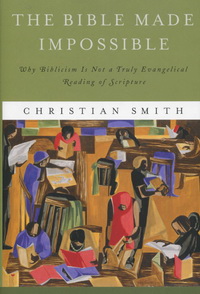
The Bible Made Impossible

I recently published a review of Christian Smith's The Bible Made Impossible: Why Biblicism Is Not a Truly Evangelical Reading of Scripture for The Denver Journal. Here's the first paragraph:

It’s not often that a professor attempts to dissolve the edifice of evangelicalism with a single book. But that is essentially what Christian Smith, Professor of Sociology at Notre Dame, has tried to do with his latest work The Bible Made Impossible: Why Biblicism is Not a Truly Evangelical Reading of Scripture (Brazos Press, 2011). Perturbed with popular use of the Bible in American evangelicalism, Smith decries modern “biblicism” (defined below) as not only irresponsible, but “impossible” – a theory that doesn’t work in practice. He endeavors to show readers the flaws of biblicism and then make a case for a “truly evangelical” reading of Scripture. Although peppered with helpful insights, The Bible Made Impossible falls short of its lofty goals, and leaves readers looking for solid ground amidst the shifting sands of academic criticism. (Here's the rest of the article...)

Tuesday, January 31, 2012

Prison University Project

Several months ago I was driving to work and overheard a program on NPR about “The Prison University Project.” In San Quentin Penitentiary, ex-cons and felons, (incarcerated for crimes ranging from drug dealing to murder) have the opportunity to get a liberal arts degree through a unique program launched in the mid-nineties by a UC Davis professor. An extension site of Patten University, prisoners with at least a GED or high school degree can earn a two year liberal arts degree, with classes ranging from US History and Algebra to English Composition and philosophy. At least in one US prison, inmates trade in dope dealing for Kant, integrals, and civil war history.

So how does one pull off a university extension site behind bars? Well, the teachers are nearly all volunteers, all with at least a masters degree in their field. Because the government outlawed Pell Grants for inmates in 1994 (a “disaster” according to the Prison University Project (PUP) website), all funding is through private foundations and donors. Students must apply and be accepted into the program, with the criteria being centered on how bad a student wants to improve themselves and grow. Classes are held primarily in evenings, and students do homework throughout the week.

What’s the need for such a program? For one, the recidivism rate among inmates is a major problem. With 2.6 million prisoners in the US, it's problematic when inmates often learn in jail how to become better criminals. If one wanted to improve himself, the typical opportunities in jail are either work programs or GED programs, which give ex-cons just enough education to get a minimum wage job upon release and be eventually drawn into “more lucrative” affairs on the street. The Prison University Project offers are real alternative – a way to earn an accredited degree and a shot at a brighter future. Moreover, a liberal arts education gives students the ability to adjust to several different jobs upon re-entry, and not only in narrowly defined technical jobs that may or may not be available when their parole is up.

But does this program really work? Who’s going to hire an ex-con to work at their corporation, even if he has a liberal arts degree? Bard College launched a similar program in an attempt to answer this question. In contrast to PUP, the Bard Initiative offers four year degrees, and produced graduates in fields ranging from computer science to comparative literature.

One student at the Bard Prison Initiative, Anthony Cardenales, graduated from the program and was eventually hired by a company called WeRecycle!. Cardenales had a unique set of skills that made him a perfect fit for WeRecycle!. First, because he was just getting out of jail, he was highly motivated to work hard, even on the floor as a materials handler. Failure was not an option for Cardenales, and his work ethic eventually pushed him up to management. But what was unique about Cardenas is that he combined a work ethic with a liberal arts degree, which gave him the critical thinking skills and higher reasoning ability needed to solve company-wide problems. In contrast to either those who will do menial labor yet are not capable of leadership responsibilities, or those with a college degree who won’t “get their hands dirty,” Cardenales brought together both skills because of his unique background.

I’m drawn to programs like PUP for many reasons. First, here is a form of education that is really changing lives. Students who are admitted have both the direct need and the motivation to change. Also, PUP is also solving a fundamental social problem in America: the recycling of prisoners through the US prison system. Graduates of programs like the Prison University Project are given the tools to truly “make it” on the outside. Yet, what is most beautiful about these types of programs is the dynamic harmony between the life of the mind and social justice, between what Bertrand Russell deemed the “heaven of philosophy” and the suffering of mankind. Here is an opportunity for the intellectually, and often introspectively, oriented individual to use his or her skills for the good of another. This is a great opportunity for those on the outside to walk along side of another human being and see them transform over time to become a contributing member of society.

Here’s my question: when is somebody going to start a program like this in Denver?

Wednesday, January 25, 2012

A New Liberal Arts

Several years ago, Liz Coleman, the president of Bennington College, gave a talk at TED about “A New Liberal Arts.” At a conference usually reserved for technology whizzes or scientists, she gave a convincing argument for the worth of a liberal arts education in an age where hyper-specialization is seen as the apex of human endeavor. Yet what was most compelling to me was her central idea: the liberal arts must be intentionally focused on thinking about and solving the world’s biggest problems.

Here’s the idea: in today’s world, not only do we need people who can think in interdisciplinary ways, but we need people using the best tools of thought from history (literature, science, history, economics, philosophy, rhetoric, mathematics) to be intentionally engaged in solving difficult problems. From climate change and education reform to international conflict and malnutrition, Coleman doesn’t believe the technician can solve these problems alone. They need broad thinkers, and they need a moral vision.

Now, I significantly disagree with several aspects of Coleman’s vision. For one, she’s staunchly secular and anti-religious. In her talk, she even spoke about their new research center at the center of campus as a kind of “secular church.” She sees no place for religion in the academy, and this, I believe, damages her argument in a religious world. Second, her form of education is avowedly political. Without God, she needs an ultimate purpose, and for her that is the state. Considering 20th century history, I’m not sure how she could be so adamantly political and unflinchingly believe in the virtues of even democracy, whom Churchill has even said is only “the least bad form of government we have.” As one who sets her heart on the state, Coleman would be wise to at least admit the truth: the secular academy is her church, and secularism is her religion.

But setting this aside for the moment, I’m more than fascinated by this model of education. Here’s why. First, Coleman believes that directly connecting a human need or real-world issue to a liberal arts curriculum super-charges thinking. For example, her freshman all have to sit in on “labs” focused on some issue, such as education or health care. In class, when they read Whitehead’s The Aims of Education, they apply it’s lessons to the national education reform debate. How many times have each of sat in class and wondered why we have to learn this? For students at Bennington, it’s clear: to change society. This means syllabi and pre-fabricated papers take second place to real critical thought on the toughest problems of our day.

Second, there is always a criticism that education is an ivory tower, disconnected from “the real world.” Not here. In this new liberal arts curriculum, the core ends are not only mastery of a subject, but instead the mastery of using that subject to benefit the common good. Conversations on literature and history take on new significance when you’re required to do a semester of “field work” dealing with real problems like poverty, governance, or disease.

Third, this new liberal arts curriculum, I believe, is deeply missional. Now, it’s obvious Coleman would never agree with me on this. I’d probably classify as a nutty fundamentalist in her eyes. But having this outward focus in a liberal arts curriculum I believe is resonant with God’s activity in the world. In contrast to most Christian liberal arts curriculums that only do mission trips and service projects, this re-centers the curriculum itself around the pressing issues at hand. For example, instead of going to Central America to build a school, they would analyze the issues of public education in Central America as well as the challenge of development education in their actual courses. God is in the business of bringing, in the words of the Lausanne Covenant, the whole gospel to the whole world. Solving problems like climate change or corporate corruption as a part of a liberal arts curriculum saves The Great Conversation from being stuffy and elitist. It focuses the liberal arts where Milton says it should always be focused, “on repairing the ruins of our first parents.”

Monday, January 9, 2012

Knowledge and Suffering

Vernon Grounds, the former Chancellor of Denver Seminary, quotes atheist philosopher Bertrand Russell to conclude his short work Evangelicalism and Social Responsibility. As an educator myself who, like Grounds, cares deeply about social justice, I thought it fitting to include the quote on this blog:

“Three passions, simple but overwhelmingly strong, have governed my life: the longing for love, the search for knowledge, and unbearable pity for the suffering of mankind. These passions, like great winds, have blown me hither and thither, in a wayward course, over a deep ocean of anguish, reaching to the very verge of despair.

“Love and knowledge, so far as they were possible, led upward toward the heavens. But always pity brought me back to earth. Echoes of cries of pain reverberate in my heart. Children in famine, victims tortured by oppressors, helpless old people a hated burden to their sons, and the whole world of loneliness, poverty, and pain make a mockery of what human life should be. I long to alleviate the evil, but I cannot, and I too suffer.”

This morning I read a headline in the Denver Post about 550,000 Haitians still living in tent cities without running water or sewer lines two years after the earthquake. One father of two young girls said, “It’s hell.” As we educators continue to pursue truth and knowledge that lift us and our students to the heavens, let us never forget of the suffering of mankind. And as we plunge back to earth, perhaps we can take something from the silver lining that will alleviate the pain that makes a mockery of what human life should be.

Revelation

“You are worthy to take the scroll
And to open its seals,
Because you were slain,
And with your blood you purchased men for God
From every tribe and language
And people and nation.
You have made them to be a kingdom and priests to serve our God
And they will reign on the earth.”
-Revelation 5:9-10

On this blog I often consider the purpose of education. Why teach? What are we trying to form in students? To find an answer to these questions, it’s helpful to think about the more fundamental question, What is the purpose of the human race?

As Lesslie Newbigin has pointed out in Foolishness to the Greeks, purpose and meaning are always connected to final outcomes. For example, if I see a machine making Coke bottles, I know it’s purpose: to make bottles. But if I see the machine sitting in a corner with a piece missing, I have no idea what its purpose is.

In the same way, the purpose of humanity is connected to its final outcome. And the final outcome of the human race is outlined in Revelation. Now, the book is interspersed with songs and poems, sung primarily by angels, but also by the “twenty-four elders” and “the four living creatures.” The elders and the four living creatures sing the song written above. To me, it’s interesting to look at the types of things people and will be doing and saying in eternity, especially as I think about what I should be doing and saying now.

The song above has at least important ideas: gospel, global mission, service, and dominion. First, the gospel is eternally on the tongue of both men and angels: the Lamb has been slain and has purchased men for God at the price of his blood. Second, people from “every tribe and language and people and nation” are at the wedding feast of the Lamb. It is a multi-cultural event. Third, men who were once far from God and estranged from him are made to be “a kingdom” and “priests” who serve God. Priests intercede on behalf of others, and service is, it seems, an eternal activity. Finally, men once again are restored to the role of being kings on the earth who reign, and thus steward the entire created order and oversee its restored state.

As we consider models of Christian education, are the elements of gospel, global mission, service and stewardship over the earth included in our curriculum? The songs of angels and redeemed people offer us clues to a true formation for students, resulting ultimately in worship.